



How to Catch Up on Unfiled Small Business Taxes In Canada (without the Panic)
Falling behind on your small business taxes is surprisingly common, but ignoring the backlog only makes the situation more stressful and expensive. Whether you are missing a single fiscal year or several years of unfiled T2 corporate returns, sole proprietorship T2125 filings, or GST/HST returns, getting back on track with the Canada Revenue Agency (CRA) is entirely manageable when approached step by step.
Here is a practical guide on gathering your records, estimating penalties, and bringing your Canadian tax filings current.
1. Stop the Panic and Take Inventory
The CRA prioritizes voluntary compliance over punishment for business owners who take proactive steps to fix their tax backlog. Before diving into calculations, assemble a basic summary of what is currently outstanding:
- Filing Types: Confirm whether you owe Corporate Income Tax (T2), Sole Proprietor/Self-Employed Tax (T1 + Schedule T2125), or GST/HST returns.
- Missing Years: Log into your CRA My Business Account or My Account portal to confirm exactly which tax years or reporting periods are flagged as unfiled.
- Notices Received: Gather any Request for Returns, Requirements to Pay, or arbitrary assessment notices sent by the CRA.
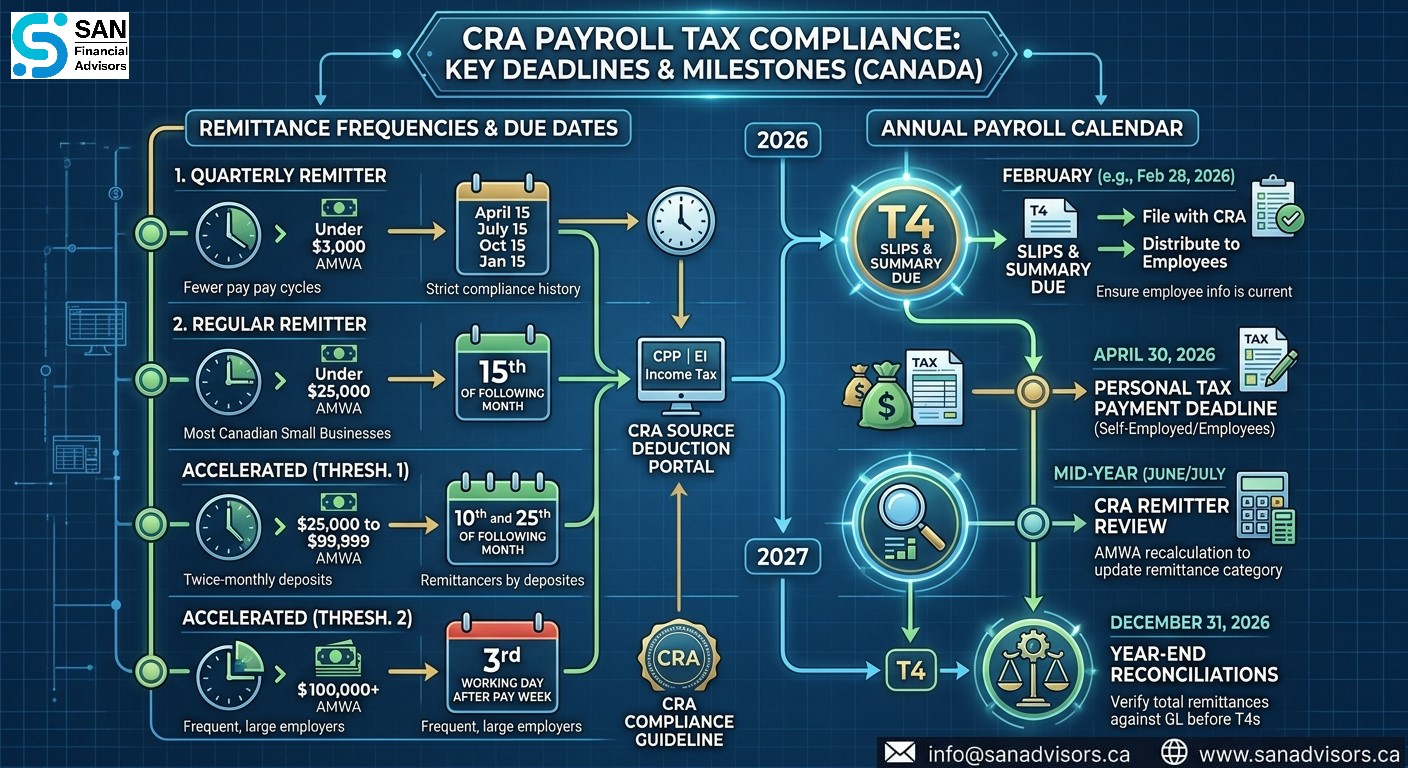
Overview of Canada Revenue Agency (CRA) payroll remittance frequencies, due dates, and key annual compliance deadlines.
To file accurate back taxes, you need clear source documentation for each unfiled period:
- Bank and Credit Card Statements: Secure full monthly statements for all business accounts covering the entire unfiled timeframe.
- Sales and Revenue Records: Gather invoices issued, POS system summary reports (Square, Shopify, Stripe, etc.), and merchant processor statements.
- Expense Receipts and Invoices: Organize documentation for supplier costs, software subscriptions, office space, utilities, and professional fees.
- Prior Tax Returns: Obtain your last successfully filed return to establish carry-forward balances, Undepreciated Capital Cost (UCC) for asset depreciation, and non-capital losses.
” Tip: If you are missing physical receipts, bank and credit card statements serve as the foundational bedrock to reconstruct your financial history during a catch-up bookkeeping process. “
3. Reconstruct Your Books First
You cannot file an accurate tax return directly from a raw folder of bank statements. Your numbers must first be organized into a proper General Ledger, Balance Sheet, and Profit & Loss statement.
- Reconcile Cash and Card Accounts: Ensure every deposit is matched to verified sales income and every withdrawal or purchase is properly categorized.
- Identify Input Tax Credits (ITCs): For GST/HST registrants, thorough cleanup ensures you claim every dollar of GST/HST paid on business purchases, directly reducing what you owe to the CRA.
- Separate Personal and Business Expenses: Isolate non-business transactions to ensure your deduction claims comply with CRA guidelines.
” Reconstructing multi-year books yourself can quickly become overwhelming. Our team at SAN Financial Advisors handles full cleanup and catch-up bookkeeping to ensure no eligible deduction is left behind. “
4. Understand CRA Late-Filing Penalties and Interest Rates
Filing late incurs automatic penalties from the CRA, which accrue compound interest daily until the balance is settled. Note that penalty formulas differ between income tax and GST/HST:
Income Tax Late-Filing Penalties (T2 Corporate & T1 Self-Employed)
- Standard Penalty: 5% of your balance owing, plus 1% of your balance owing for each full month the return is late (up to a maximum of 12 months).
- Repeated Late Filing: If the CRA issued a demand to file or penalized you for late filing in any of the three preceding tax years, the penalty doubles to 10% plus 2% per full month late (up to 20 months).
GST/HST Late-Filing Penalties
- Standard Rate: Calculated as 1% of the net tax owing, plus 0.25% of the net tax owing per full month late (up to a maximum of 12 months).
CRA Arrears Interest
The CRA compounds interest daily on overdue tax balances and unpaid penalties at their prescribed rate.
” Filing your return as soon as possible halts the late-filing penalty from growing, even if you cannot pay the full tax balance immediately. “
5. Explore CRA Relief Options
If you come forward voluntarily before the CRA initiates enforcement action, you may qualify for taxpayer relief mechanisms:
Voluntary Disclosures Program (VDP)
If accepted under the VDP, the CRA may grant relief from criminal prosecution, waive administrative late-filing penalties, and provide partial interest relief (up to 75% relief on accrued interest for unprompted disclosures).
VDP Eligibility Requirements:
- The disclosure must be voluntary (submitted before the CRA contacts or audits you regarding the unfiled periods).
- The tax return or information must be at least one year past due.
- The disclosure must involve a penalty or interest exposure.
- It must include complete information for all unfiled periods.
Taxpayer Relief Provisions
If your tax backlog was caused by circumstances beyond your control, such as severe illness, personal hardship, financial distress, or a natural disaster, you can submit a Taxpayer Relief request to cancel penalties and accrued interest.
Get Professional Help Catching Up
Reconstructing years of backlogged books while interpreting CRA tax compliance rules takes significant time and attention. Working with a dedicated accounting advisor allows you to hand off the cleanup process, maximize eligible expense deductions, and bring your CRA account back into good standing.
Ready to Get Your Books and Tax Filings Back on Track?
Have questions about how back-tax cleanup works? Explore our Frequently Asked Questions page, or contact SAN Financial Advisors today for a free, zero-pressure initial consultation.
Fill out our quick form at www.sanadvisors.ca/contact-us or send us a direct message to review your options and map out a step-by-step cleanup plan.